The Unseen Leaf: Inside the Blind Tasting Circuits Redefining American Tea Connoisseurship
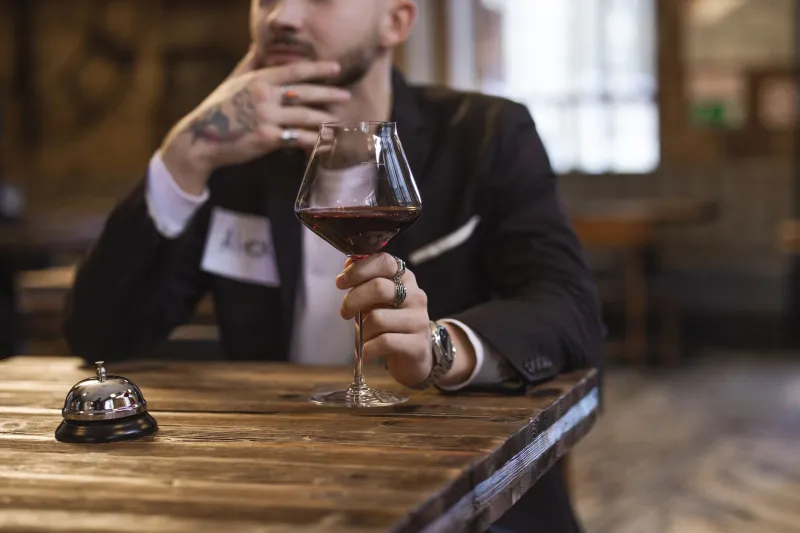
The Cup That Conceals Everything
The vessel arrives without ceremony. There is no label, no origin card, no estate name printed on elegant paper beside the saucer. The liquor within — perhaps amber, perhaps gold, perhaps a deep and complex mahogany — offers its color as the first and only unprompted disclosure. Everything else must be earned through attention.
This is the defining condition of the blind tasting, and it is precisely this condition that a growing number of America's most sophisticated tea enthusiasts are seeking out with increasing frequency. Modeled on the rigorous evaluation protocols long established in fine wine and single malt whisky culture, the blind tea tasting circuit is emerging as one of the more intellectually demanding — and socially exclusive — arenas in American luxury food culture.
What happens in these rooms, and what the results reveal about the nature of quality, is reshaping the way a discerning generation of collectors thinks about tea.
Why Blind Tasting, and Why Now
The wine world's most celebrated blind tasting — the 1976 Judgment of Paris, in which California wines defeated their French counterparts before a panel of French judges — demonstrated with unforgettable clarity what removing labels from the equation can accomplish. It strips away the scaffolding of reputation and price and forces the evaluator to confront what is actually in the cup.
American tea culture has arrived at a comparable moment of self-examination. As the market for fine teas has matured — as auction results for aged pu-erh have climbed into the tens of thousands of dollars per cake, as first-flush Darjeeling allocations have become competitive, as the vocabulary of tea evaluation has grown more precise — the question of whether price and prestige reliably track quality has become impossible to avoid.
Blind tasting provides the most honest available answer.
"What we consistently find," says one organizer of a quarterly blind tasting series held in a private dining room in Manhattan, "is that the teas which perform best when the identity is concealed are not always the ones carrying the highest price tags. Sometimes they are. But the correlation is far from perfect, and that imperfection is extraordinarily instructive."
The Format and Its Rigor
The most serious blind tasting events operating in the United States today draw their methodological inspiration from established professional evaluation frameworks, adapted thoughtfully for tea's specific sensory demands. Participants typically evaluate teas in flights of four to eight, assessing appearance of the dry leaf, liquor color and clarity, aroma at multiple stages — hot, cooling, and in the emptied cup — and flavor across a structured sequence of sips.
Scoring systems vary by event, but the most rigorous competitions employ numerical rubrics that assign weighted values to individual sensory attributes: fragrance and aroma, flavor complexity, body and texture, finish length, and what experienced evaluators describe as coherence — the degree to which all elements of a tea's profile resolve into a unified, intentional whole.
The physical environment is managed with the same care as the scoring methodology. Neutral lighting eliminates color bias. Palate cleansers — typically still water and occasionally unsalted crackers — separate flights. Participants are asked to refrain from wearing fragrance, a requirement that signals immediately the seriousness of the undertaking.
The Judges and What They Bring
The individuals presiding over the most prestigious American blind tasting events represent a notably diverse cross-section of expertise. Credentialed tea sommeliers trained through programs affiliated with the World Tea Academy or the Specialty Tea Institute sit alongside collectors with decades of market experience, importers who have spent years at origin, and, increasingly, sensory scientists with backgrounds in food chemistry.
This interdisciplinary composition is, organizers argue, a deliberate feature rather than an accident. A collector who has tasted hundreds of aged pu-erh cakes brings pattern recognition that no academic training can replicate. A sensory scientist brings a descriptive precision and resistance to confirmation bias that experience alone does not guarantee. The combination, when it functions well, produces evaluations of unusual authority.
Several events have begun inviting master sommeliers from the wine and spirits worlds as guest panelists — not because their tea expertise is assumed to be comparable, but because their palate discipline, their ability to disaggregate complex flavor profiles and articulate what they are perceiving with precision, translates meaningfully across categories.
What the Results Are Teaching the Market
The cumulative data emerging from multiple seasons of blind tasting events is beginning to tell a coherent story, even if that story occasionally confounds received wisdom.
High-elevation teas, as a category, tend to perform with remarkable consistency regardless of estate name or marketing positioning. The physiological stress of altitude — lower temperatures, higher ultraviolet exposure, reduced atmospheric pressure during growth — appears to produce structural complexity that evaluators reliably recognize and reward, even without the guidance of a label.
Processing transparency is another recurring theme. Teas whose producers have maintained traditional, minimally interventionist processing methods — without the application of artificial heat to accelerate oxidation, without blending to smooth inconsistency — tend to display the kind of distinctive, place-specific character that scores well in blind conditions. Homogenized teas, however expensively packaged, frequently disappoint.
Perhaps most significantly, the blind format has begun to rehabilitate certain producing regions that have historically occupied secondary status in the American collector's hierarchy. Teas from lesser-discussed districts of Fujian, from emerging gardens in Nepal's Ilam valley, and from micro-producers in Japan's less-celebrated prefectures have, in blind conditions, occasionally outscored far more prominent competitors. These results are not merely interesting; they are market-moving.
The Social Architecture of a Serious Tasting
Beyond the evaluative function, blind tasting events serve a social purpose that is inseparable from their appeal within affluent collector communities. They provide a setting in which expertise is the primary currency — more relevant, in the moment of evaluation, than net worth or social position. A collector who can articulate, with accuracy and precision, why a particular Wuyi oolong's roast character suggests a specific production timeline commands a form of respect that no auction paddle alone can purchase.
These gatherings are also, candidly, among the most effective networking environments in American luxury culture. The individuals who attend serious blind tasting events tend to be precisely the kind of collectors, importers, and market participants whose relationships translate into early access to exceptional material — the estate allocations, the private acquisitions, and the rare offerings that never reach general retail.
The Democratization of Discernment
There is a productive tension at the heart of the blind tasting movement: it is, simultaneously, highly exclusive and genuinely egalitarian in its evaluative logic. Entry to the most prestigious events is not easily obtained. But once inside, the only credential that matters is the quality of one's perception.
In this sense, the blind tasting circuit may represent the most honest expression of what serious tea culture aspires to be — a domain where the leaf, evaluated without the distortion of prestige or price, speaks entirely for itself. For the American collector willing to develop the palate required to hear it, that conversation is one of the most rewarding available.