Vintage Without a Year: How a Changing Climate Is Writing New Rules for Rare Tea Collecting
When the Weather Becomes the Vintage
In the vocabulary of fine wine, the vintage year carries enormous weight. A single season of ideal conditions can elevate an entire appellation, producing bottles that command multiples of their ordinary price for generations. Tea collecting has historically operated differently — prizing age, processing tradition, and estate provenance above the particularities of any given harvest year. That calculus is changing, and the force driving the change is one no estate manager, however skilled, can control: the weather.
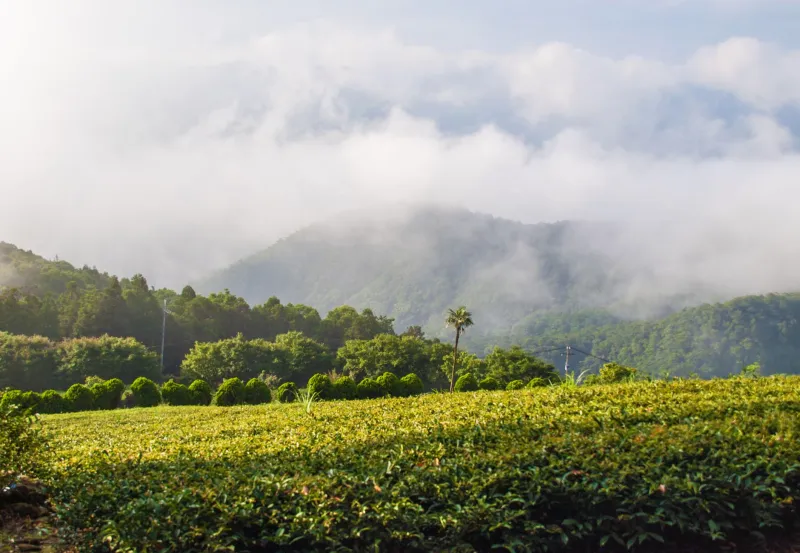
Across Darjeeling's high-altitude gardens, the mountain districts of Yunnan, the misty hillsides of Taiwan's central ranges, and the ancient tea forests of Sri Lanka's Uva Highlands, growers are reporting harvest conditions of increasing unpredictability. Late monsoons, early frosts, unseasonal drought, and aberrant fog patterns are disrupting the rhythmic cycles that have defined tea agriculture for centuries. For the estates themselves, this volatility represents genuine hardship. For a specific class of collector — patient, well-informed, and strategically positioned — it represents something else entirely.
The Meteorology of Rarity
Understanding why climate variability creates collectible value requires a brief consideration of what makes any tea genuinely rare. Volume is the primary factor: a harvest diminished by drought or frost produces fewer leaves, and fewer leaves means fewer tins, fewer allocations, and a smaller pool of material that will survive the decades required to achieve peak aged character.
But scarcity alone does not account for the full picture. Climate stress, when it falls within a specific range — neither so severe as to damage the plant nor so mild as to leave no impression on the leaf — can produce flavor compounds of unusual complexity. Extended cold snaps slow the growth of the tea shoot, concentrating amino acids and aromatic precursors in ways that ideal growing conditions do not. Certain prized oolongs from Taiwan's high-elevation gardens owe their distinctive character to exactly this kind of meteorological pressure.
"There are harvests I have encountered where the grower was genuinely distressed by the season's conditions," recalls one American importer who specializes in micro-lot teas from across Asia. "And when I tasted the result, I understood immediately that something unusual had occurred. The profile was unlike anything from that garden in the previous decade. Those are the teas I move quickly to acquire, because I know they will not come again."
Regional Disruptions Worth Watching
Darjeeling, India's most celebrated tea district, is experiencing some of the most dramatic shifts. The first flush — that brief, luminous spring harvest that produces the region's most sought-after teas — is increasingly subject to erratic pre-monsoon rainfall and temperature swings that can compress the picking window to a matter of days. In years where conditions conspire to create a compressed, intensely flavored first flush of very limited volume, the resulting teas represent genuine micro-vintages: singular expressions of a specific place at a specific, unrepeatable meteorological moment.
In Yunnan province, the ancient tea trees of Xishuangbanna — some centuries old, producing the raw material for the most prized aged pu-erh — are contending with shifting rainfall distribution. Dry seasons of unusual duration are affecting the character of spring harvests from trees that have, until recent decades, operated within relatively stable climatic parameters. The teas emerging from these conditions are different: not necessarily better or worse by conventional measure, but genuinely distinct, and genuinely unrepeatable.
Taiwan's high-mountain oolong districts, particularly the gardens above 2,000 meters in Nantou County, are seeing frost events of increasing irregularity. When a late frost strikes during the spring growth period, it can damage a significant portion of the harvest while leaving certain micro-plots — sheltered by topography or elevation — largely intact. The teas from those protected plots, produced in quantities that may be measured in kilograms rather than tons, represent the kind of scarcity that sophisticated collectors have learned to pursue aggressively.
The Strategic Collector's Approach
For American tea enthusiasts seeking to position themselves advantageously in this emerging landscape, the primary challenge is informational. The window between a climatically significant harvest and its availability on the international market can be measured in months, and those months favor buyers with established relationships at the source.
Building those relationships — with trusted importers who maintain direct ties to estates, with specialist brokers who monitor growing conditions in real time, and with the small number of American retailers who allocate micro-lot acquisitions to known clients before general release — is the foundational work of the climate-aware collector.
Subscription to estate newsletters, participation in collector networks with international reach, and engagement with the small but growing community of American tea buyers who travel to origin regions during harvest season are all practical avenues. The collector who arrives in Darjeeling during first flush, or who maintains a standing order with a Yunnan broker for any single-tree harvest material, is operating with informational advantages that no amount of retrospective purchasing can replicate.
Preservation and the Long View
Acquiring a climate-affected micro-vintage is only the beginning of a long-term commitment. The teas most likely to appreciate in significance over time — aged pu-erh in particular — require proper storage conditions maintained across years or decades. Temperature stability, appropriate humidity, and isolation from strong odors are the foundational requirements, and serious collectors invest accordingly in dedicated storage that preserves the integrity of their holdings.
The analogy to wine collecting is instructive but imperfect. Unlike a bottle, which offers a single, irreversible tasting moment, a tea cake or a tin of aged white tea can be sampled incrementally, allowing the collector to monitor its evolution over time without exhausting the holding. This is one of the qualities that makes aged tea particularly suited to the patient, long-horizon collector.
An Unrepeatable Record
There is something philosophically compelling about a tea that carries, in its flavor, the record of a specific season's meteorological drama. The frost that compressed the harvest. The drought that deepened the concentration. The unseasonal warmth that accelerated the bloom and shortened the window.
For the collector who understands this dimension, acquiring a genuine climate-affected micro-vintage is not merely a financial calculation. It is the acquisition of a moment — specific, documented, and permanently beyond reproduction. In a market increasingly populated by limited editions engineered for marketing purposes, that authenticity carries a value that no press release can manufacture.