The Still Point: How America's Most Discerning Individuals Are Discovering Ritual in the Teacup
The wellness industry in the United States generates upward of $480 billion annually, and yet a persistent dissatisfaction runs through its most devoted consumers. The supplements accumulate on the shelf. The spa treatments deliver temporary relief. The meditation apps are opened, then abandoned. Something is missing — not efficacy, exactly, but meaning. The rituals that sustain well-being over a lifetime, practitioners and researchers increasingly agree, require more than clinical optimization. They require beauty, intention, and a connection to something larger than the self.
This is precisely the ground that ceremonial tea practice has begun to occupy in the lives of a growing number of affluent Americans. From the private tea rooms of Manhattan to the morning routines of Silicon Valley executives and the curated wellness retreats of Aspen and Montecito, the deliberate preparation and consumption of premium tea — approached not as a beverage transaction but as a contemplative ritual — is emerging as the self-care practice that endures when others have come and gone.
The Inadequacy of the Quick Fix
To understand why ceremonial tea practice has found such resonance among those who can afford any wellness experience they choose, it helps to examine what they are moving away from. The dominant paradigm of luxury wellness in America has long been defined by intervention: the IV drip, the cryotherapy chamber, the imported adaptogen blend promising cortisol regulation and cognitive enhancement. These offerings are not without merit. But they share a fundamental characteristic — they are things done to the body, rather than practices engaged in by the person.
Dr. Renata Holloway, a New York-based integrative psychiatrist who works with a clientele that includes executives, artists, and public figures, has observed a notable shift in her patients' self-care interests over the past several years. "There is a real fatigue with passive consumption in the wellness space," she notes. "My patients who are finding the most sustainable benefit are those who have adopted practices that require presence and skill — practices that engage the mind as an active participant rather than a passive recipient. Tea ceremony, for many of them, has become exactly that."
The Traditions Behind the Practice
Ceremonial tea is not a single tradition but a family of related practices, each shaped by centuries of cultural refinement and each offering a distinct approach to the relationship between preparation, presence, and pleasure.
The Japanese Path
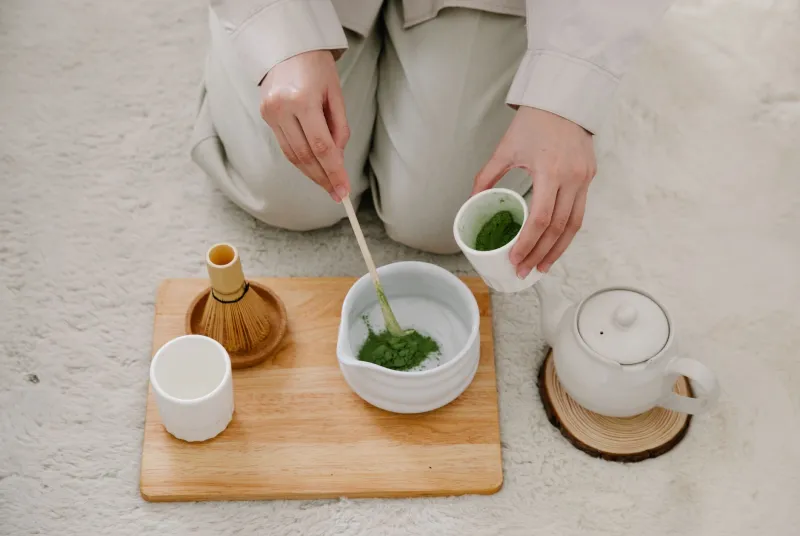
Chado — the Way of Tea — is among the most rigorously codified ritual practices in the world. Developed through the influence of Zen Buddhism and brought to its classical form by the 16th-century master Sen no Rikyu, the Japanese tea ceremony centers on the preparation and sharing of matcha in an environment of deliberate simplicity. Every gesture — the folding of the fukusa cloth, the rotation of the bowl before drinking, the precise arc of the chasen (bamboo whisk) — carries meaning. The practice cultivates what practitioners call ichigo ichie: the recognition that this moment, this gathering, will never occur again in precisely this form.
For American practitioners, the appeal of this philosophy in an era of infinite digital distraction is not difficult to understand. Several luxury wellness destinations — including a highly regarded retreat center in Vermont and a private club in Los Angeles — now offer Chado instruction as part of their programming, taught by certified practitioners who have trained in Japan.
The Chinese Gongfu Approach
Gongfu cha — literally, "tea with skill" — is the Chinese practice of brewing premium loose-leaf teas in small, carefully calibrated infusions using dedicated clay or porcelain vessels. The emphasis is on extracting the full complexity of a high-quality tea through precise water temperature, measured leaf-to-water ratios, and successive short steepings that reveal different facets of the tea's character over time.
Where Japanese ceremony tends toward meditative austerity, gongfu cha invites a more sensory and exploratory engagement. A session with a fine single-origin Wuyi oolong or an aged pu-erh can unfold across an hour or more, with each infusion offering a subtly different expression of the same leaf. Practitioners describe a quality of absorbed attention — what psychologists might call a flow state — that is difficult to achieve through passive consumption of any kind.
The Indian Chai Ritual
While it lacks the formal codification of its East Asian counterparts, the Indian tradition of preparing and sharing masala chai carries its own ceremonial weight — one that centers on warmth, hospitality, and the unhurried rhythms of social connection. Premium versions of this tradition, using estate-grown Assam or Darjeeling teas and hand-ground spice blends of cardamom, ginger, black pepper, and cinnamon, have found an appreciative audience among American consumers who value both the sensory richness of the preparation and its grounding, convivial character.
The Luxury Tea Lounge as Urban Sanctuary
The physical spaces in which ceremonial tea practice is taking root in American cities deserve particular attention. A new category of establishment — the luxury tea lounge — has emerged in recent years that bears little resemblance to the bubble tea shop or the chain café's tea menu. These are considered, design-forward environments in which the quality of the tea, the skill of the preparation, and the atmosphere of intentional calm are treated with the same seriousness one might expect from a destination cocktail bar or a fine dining room.
In New York, several such spaces have opened in the past three years, offering curated menus of rare single-origin teas prepared to order by knowledgeable staff using precise brewing equipment. In San Francisco and Seattle — cities with historically strong connections to East Asian tea culture — the category is even more developed, with some establishments offering private tea consultation sessions and dedicated tasting rooms for serious enthusiasts.
The clientele these spaces attract is telling: professionals in their thirties and forties who are deeply informed about food and drink, who have traveled internationally and encountered tea culture in its native contexts, and who are actively seeking alternatives to alcohol-centered social rituals.
Constructing a Personal Tea Ritual
For those drawn to this practice but uncertain where to begin, the advice of experienced practitioners is consistent: start with quality and simplicity. Select a single premium tea — a ceremonial matcha, a high-mountain oolong, or a first-flush Darjeeling — and commit to preparing it properly, every morning, for thirty days. Invest in appropriate vessels: a well-made teapot, a bowl that fits comfortably in the hands, a kettle that allows precise temperature control.
The ritual does not require an hour. Even fifteen minutes of genuinely attentive preparation and consumption — away from screens, with full sensory engagement — creates a quality of pause that accumulates meaningfully over time. It is, in the most precise sense, the opposite of a quick fix. It is a practice. And in a culture that has largely forgotten the difference, that distinction is itself a form of luxury.